
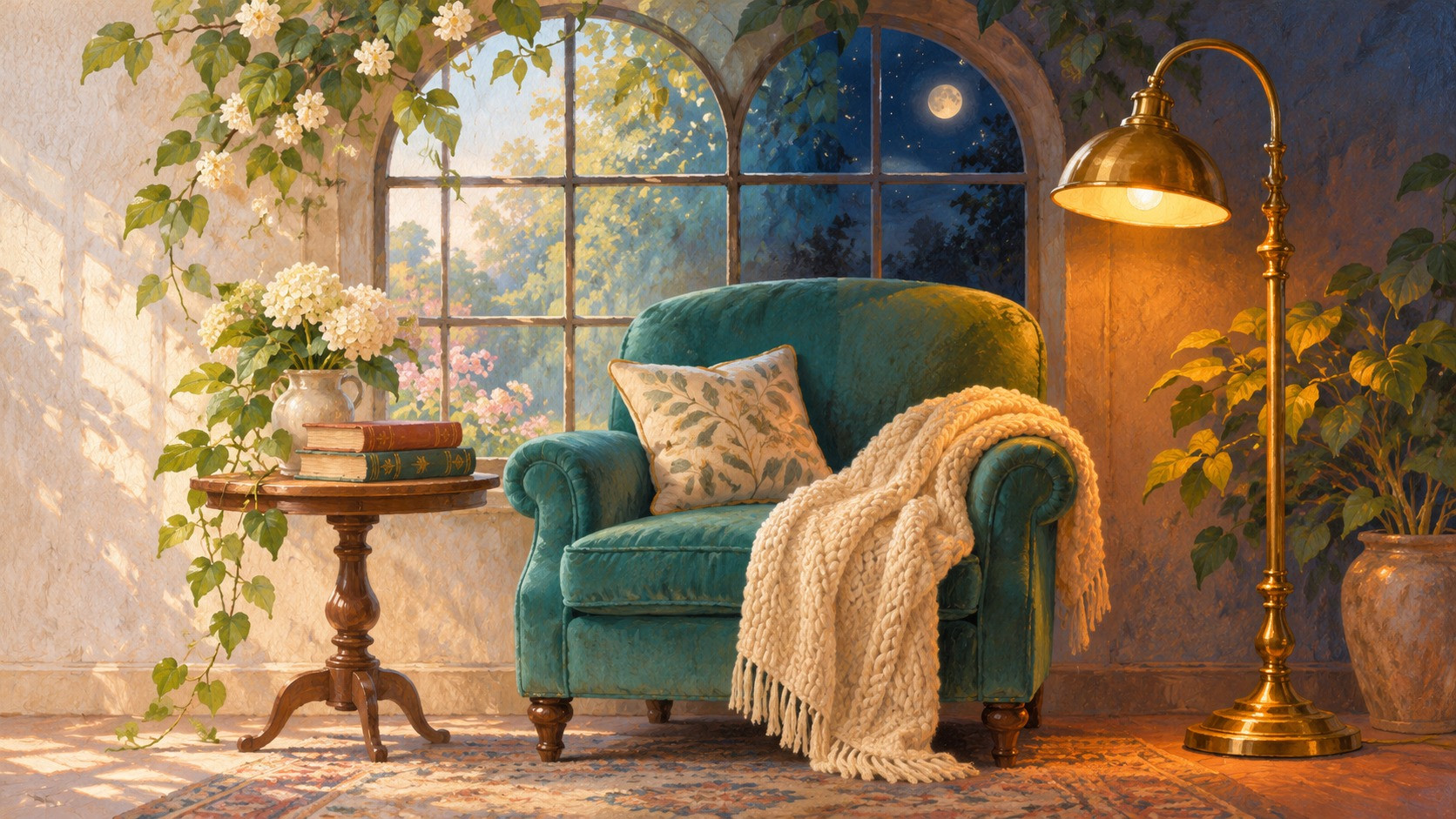
A reading nook can feel like a place to begin the afternoon or a place to finish the evening. Before committing to either direction, make two small visual proposals: the same chair, the same framing and the same gentle camera approach, once in daylight and once under a warm lamp.
The useful deliverable is a pair of clearly named alternatives. You are exploring which atmosphere expresses your idea; you are not measuring which version audiences prefer. Start with still images that communicate each mood on their own. Video can then become an optional way to present them.
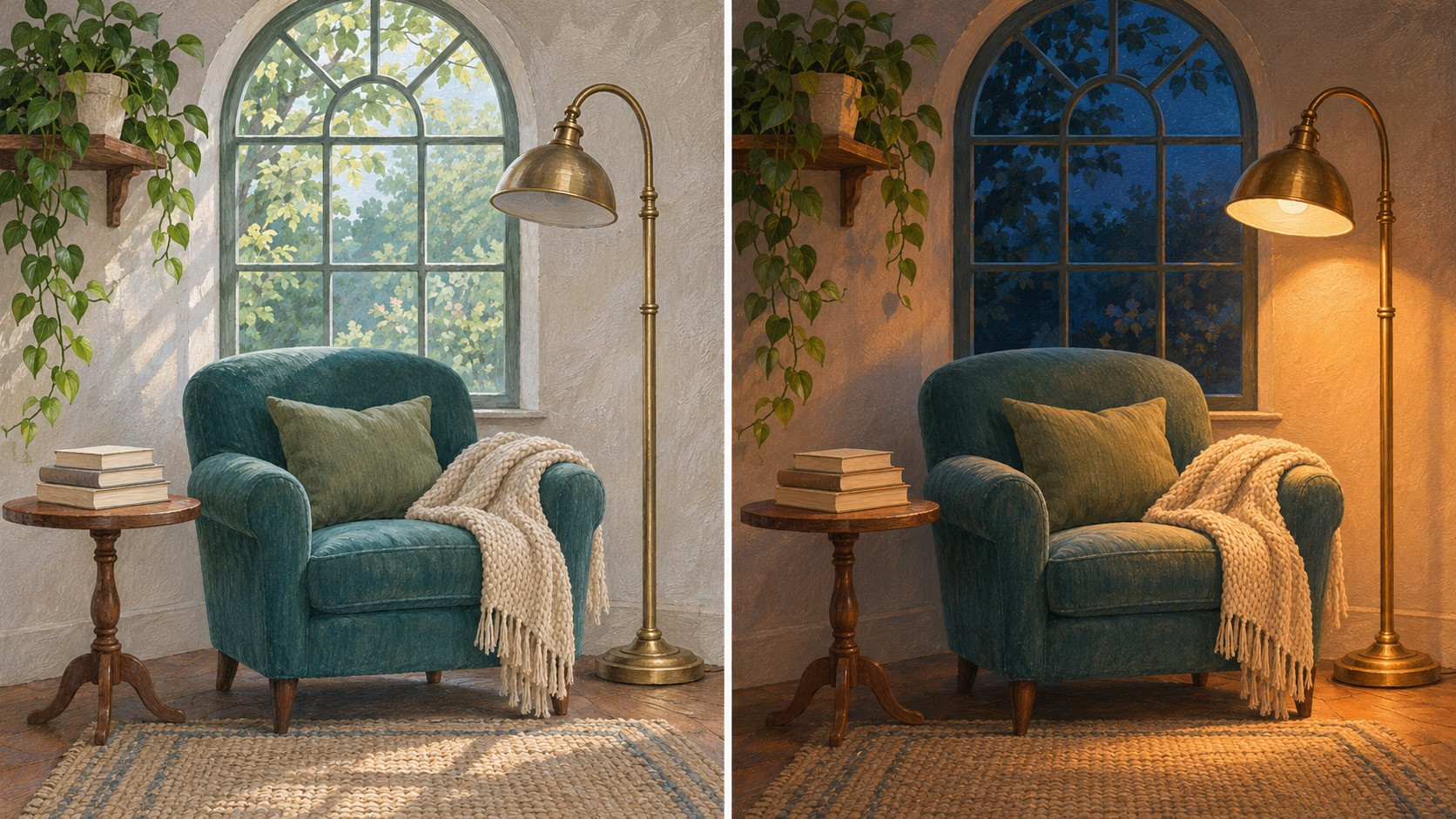
Two still mood directions for a fictional reading nook. These illustrations are not generated video frames.
Give both proposals the same job
Write one sentence before preparing the images: "Show a quiet reading corner as an inviting place to pause." Keep that sentence for both versions. If one proposal becomes a busy café while the other stays a private room, the choice now involves two different ideas rather than two treatments of the same idea.
For this fictional example, the shared scene contains a teal chair, a brass floor lamp, a small wooden table, closed books and an arched window. The day version uses diffuse window light. The night version uses warm lamplight against a darker window. Nobody enters the room and no object performs a second action.
The shared movement will be a slow, small camera approach toward the chair. This gives each proposal the same presentation intention while leaving the lighting treatment as the main creative difference. It does not make two independently generated clips a controlled scientific comparison: their details and motion can still vary.
Prepare four clean frames, not one day-to-night pair
Each proposal needs its own opening and closing image. Make four files in your image editor:
| Proposal | First image | Last image |
|---|---|---|
| Daylight | Wide reading nook in diffuse daylight | Slightly tighter view of that same daylight composition |
| Lamplight | Matching wide reading nook at night, lamp already on | Slightly tighter view of that same night composition |
Keep all four at 16:9. Within each pair, retain the chair, furniture layout and lighting direction. Between the two proposals, preserve the intended layout and camera framing as closely as your prepared artwork permits. Change the illumination and palette deliberately: cool window light for the day proposal, amber lamplight with a dark blue window for the night proposal.
For a simple framing guide, duplicate each wide still and crop a small, centered amount from the copy, then export the cropped copy back onto a canvas with the same ratio. Keep the chair fully readable and check that neither the lamp shade nor table is clipped. This tighter image describes a desired ending composition. A crop is not a recording of a camera moving through three-dimensional space, and it cannot establish the parallax that a real approach would produce.
A planning layout for four separate references: daylight first/last above, lamplight first/last below. Prepare clean single-frame files yourself; do not upload this contact sheet.
Export the four clean images separately as PNG, JPEG or WebP. Keep captions, panel borders and comparison labels outside them. An illustrated comparison sheet helps you explain the setup, but uploading that sheet would give the generator multiple panels instead of one coherent scene.
Do not combine the daylight opening with the night ending unless you actually want a changing-light shot. Here, daylight stays daylight throughout its attempt, and the lamp is already on throughout the night attempt.
Copy the daylight motion prompt
Use the daylight first and last images with this complete prompt:
Create one five-second shot of the prepared reading nook in diffuse daylight. Move the camera slowly and slightly toward the teal chair, progressing from the supplied wide first image toward the tighter last image. Keep the chair, brass floor lamp, side table, closed books and arched window in their existing arrangement. Maintain the cool, soft daylight throughout; keep the lamp off. Ask for one continuous, restrained approach with no pan, no orbit, no person entering, no moving furniture and no added lettering. End on the supplied closer composition.
The references carry the scene and the two framing targets. The prompt describes how you want the interval to behave. "Keep" and "no" clauses are instructions, not locks or guarantees. If your source contains a green chair rather than a teal one, replace that noun phrase before submitting; do not leave a text-image contradiction in the request.
Copy the lamplight motion prompt
Start a separate attempt with the two night images and the matching prompt:
Create one five-second shot of the prepared reading nook at night under warm lamplight. Move the camera slowly and slightly toward the teal chair, progressing from the supplied wide first image toward the tighter last image. Keep the chair, brass floor lamp, side table, closed books and arched window in their existing arrangement. Maintain warm amber light from the already illuminated floor lamp and a dark blue view through the window throughout. Ask for one continuous, restrained approach with no pan, no orbit, no person entering, no moving furniture and no added lettering. End on the supplied closer composition.
The main action and framing intention stay the same. Only the lighting description changes. Neither prompt asks the lamp to switch on or the sun to set; those would turn the exercise into a lighting transition and make the proposals harder to compare.
Make two independent generation attempts
The VO4 AI free image-to-video generator is one option for trying these prepared pairs. Its official free page describes five-second, 480p generation at zero credits without an account. Verification is still required, and free requests may queue. These are the page's stated conditions, not measured results from this exercise.
For the daylight attempt, add the daylight first image followed by its daylight last image. Paste the daylight prompt and choose 16:9. Complete verification, submit and preview the candidate when it is available. Download a take you want to keep; the page describes history as local to that page and browser, so save useful clips independently.
Repeat with the two night images and the night prompt. Do not assume the second attempt inherits the first pair or its settings: check the references, their order, the prompt and ratio again. Name the saved candidates clearly, such as reading-nook-day and reading-nook-lamp, using the actual extension supplied by the download.
Present the two directions without inventing a winner
A still presentation concept for discussing two atmospheres. It is not a screenshot of clips, a client selection or a measured comparison.
If both clips become useful, place them sequentially in a separate video editor, using the same display duration for each and a short label outside the artwork. A side-by-side layout is another presentation option, but each landscape clip will become smaller. Check that the chair and lamp remain readable before choosing it. This arrangement happens outside the generator; it is not a verified built-in VO4 comparison feature.
Keep the original downloaded files. Add music, labels or transitions only if your presentation needs them and you have appropriate rights. Do not let an extra effect on just one version decide the comparison accidentally.
Watch each candidate once for the overall feeling, then ask three specific questions. Does the lighting express the intended afternoon or evening mood? Does the chair remain the clear subject? Does unwanted furniture movement or a changing window distract from that mood? If a candidate wanders, simplify its request or keep the still proposal instead. Two strong stills are a useful deliverable even when no motion candidate is ready.
You can now explain a preference in terms of the proposal's purpose: daylight makes this particular composition feel open, or the warm lamp makes it feel intimate to you. That is a creative judgment. Audience preference, client approval and performance would require their own evidence. This exercise ends with two directions you can discuss, rather than a claim that one has already won.