
Artificial intelligence is becoming a practical part of digital transformation for small and medium businesses. AI can help companies automate routine work, improve customer service and make better use of business data. The shift is already visible across the market. The OECD reported that 20.2% of firms across OECD countries used AI in 2025 compared with 14.2% in 2024.
Why AI Matters for Small and Medium Businesses
For many smaller businesses the biggest challenge is doing more with limited people and resources. AI can help reduce repetitive work without requiring a complete change to existing operations. Teams can use AI for customer questions, document processing, sales support, content tasks and internal reporting. This allows employees to spend more time on work that requires judgment and direct customer interaction.
AI adoption is also becoming easier because businesses can start with ready-made tools. The 2026 OECD D4SME Survey found that most SMEs are using off-the-shelf AI products while some are moving toward more tailored applications such as AI agents. The survey also identified time constraints, maintenance costs and skills gaps as important barriers to effective adoption.
Where Businesses Can Use AI
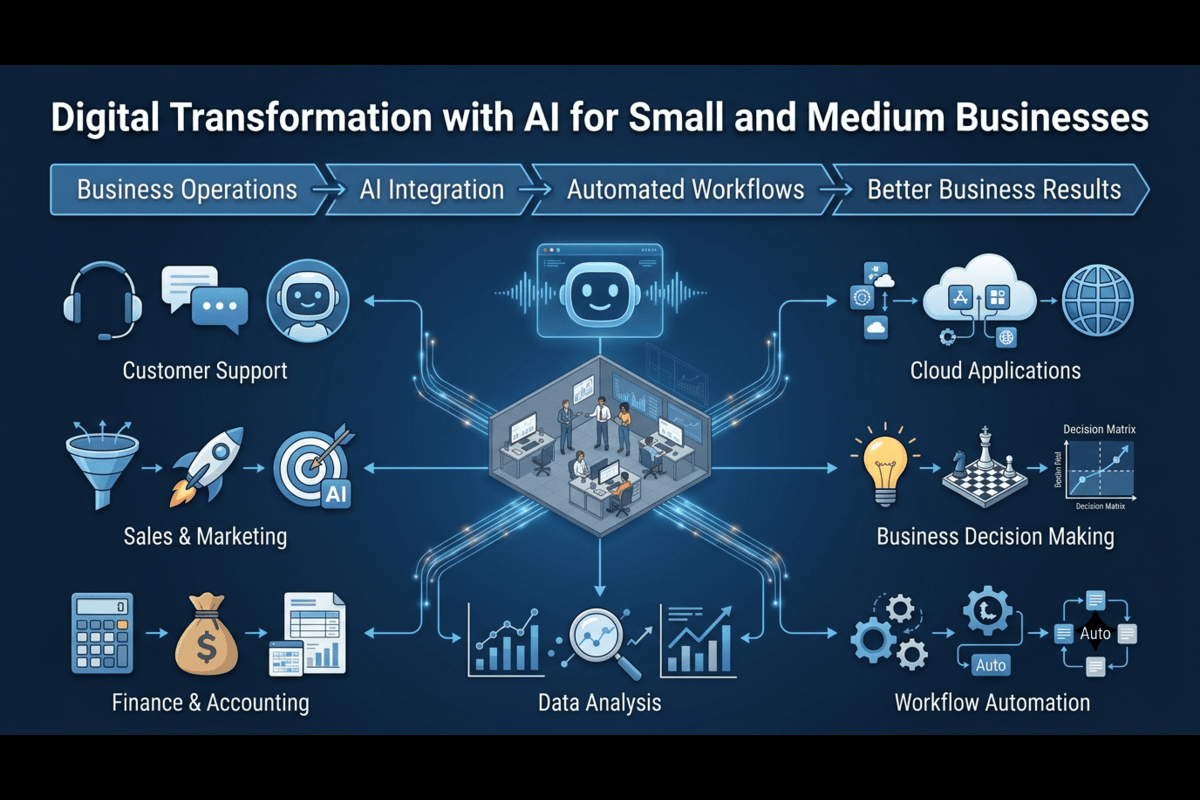
AI can support several areas of a small or medium business. Customer service teams can use AI assistants to answer common questions and organize requests. Sales teams can use AI to analyze customer information and identify follow-up opportunities. Finance teams can automate document handling and reporting. Operations teams can use AI to identify patterns in data and improve routine workflows.
The right starting point depends on the business. A company with a large volume of customer inquiries may benefit from an AI support assistant. A business that handles many documents may gain more value from intelligent document processing. Companies with complex workflows may consider custom AI solutions that connect different systems and automate specific tasks.
AI Development Services for Growing Businesses
Businesses with unique processes may eventually need more than standard software tools. AI Development Services can help companies build solutions around their existing workflows and data. This can include AI-powered applications, recommendation systems, predictive models, document processing tools and intelligent assistants.
Custom development should begin with a clear business problem. A company does not need to introduce AI across every department at once. Starting with one measurable process makes it easier to test the technology and understand its value. The results can then guide future investments.
Building a Practical AI Strategy
A successful AI strategy starts with identifying repetitive tasks and areas where employees spend significant time. Businesses should then review the available data and existing software before selecting a solution. Data quality is especially important because poor or incomplete information can reduce the usefulness of AI outputs.
Security should also be part of the planning process. Businesses may handle customer details, financial records or internal documents that require careful protection. Access controls, data policies and human review can help reduce operational risks. Employees should also understand how AI tools are being used and where human decisions remain necessary.
The Business Impact of AI Adoption
AI can create value through several paths. Automation can reduce manual effort while faster access to information can support quicker decisions. Better customer interactions can improve service quality. AI can also help smaller teams handle higher workloads without adding the same level of operational complexity.
Recent research shows growing interest from SMBs. Salesforce reported that 75% of SMBs surveyed globally were either experimenting with or had implemented AI. The survey covered 3,350 SMB leaders across 26 countries.
At the same time adoption is still uneven. OECD data shows that 17.4% of small firms used AI in 2025 compared with 52% of large firms. This gap shows that many smaller businesses still have room to build their AI capabilities.
Preparing for the Next Stage of Digital Transformation
AI adoption does not have to mean replacing existing systems. Businesses can gradually connect AI with the tools they already use. This approach can reduce disruption and give teams time to learn how new systems fit into their daily work.
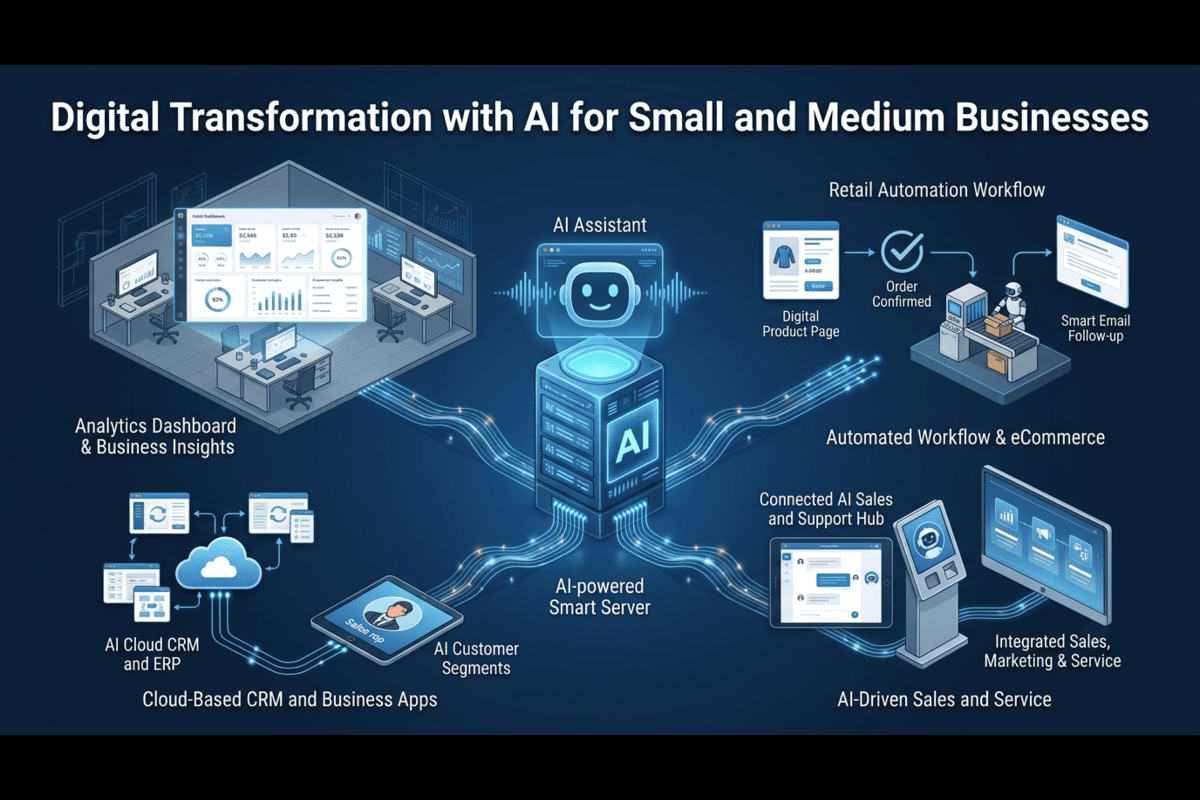
The next stage of digital transformation will likely focus on connected workflows rather than isolated AI tools. Businesses can combine data systems, automation and AI applications to create smoother processes. For small and medium businesses the goal should be practical progress that solves real operational problems.
Conclusion
AI is becoming an important part of digital transformation for small and medium businesses. Companies can begin with focused use cases and expand as their teams gain experience. The key is to connect AI investments with measurable business needs. Tech.us helps businesses explore AI opportunities and develop technology solutions that support practical digital transformation.